



NEWSROOM
NEWSROOM

News
News
[Electronic Times] WIS 2026: "From Control to Data to Real-World Validation"… Physical AI Full-Stack Self-Reliance Enters the Execution Phase
- 2026.04.24
- |
- 최고관리자
- |
- 2,042
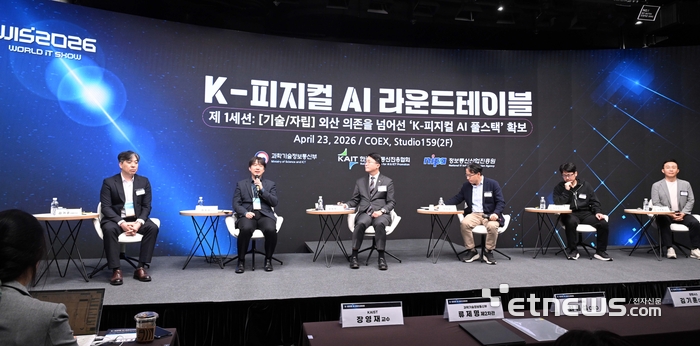
The K-Physical AI Roundtable was held on the 23rd at COEX in Samseong-dong, Seoul,
under the theme "Opening the Path to Korea as an Industrial Powerhouse through Physical AI Full-Stack Self-Reliance."
Held as part of World IT Show (WIS) 2026, the K-Physical AI Roundtable brought the government and frontline companies together to discuss practical strategies for achieving technological self-reliance in physical AI. As NVIDIA's dominance over the global AI ecosystem continues to accelerate, leading Korean companies showcased achievements across control technology, data infrastructure, and synthetic data—revealing both the current standing and remaining challenges of Korea's physical AI sector.
The Ministry of Science and ICT hosted the K-Physical AI Roundtable on the 23rd as a side event of WIS 2026. With Professor Jang Young-jae of KAIST serving as moderator, the session featured in-depth discussion among Vice Minister Ryu Je-myung, Maum AI CEO Choi Hong-sub, Movensys CEO Kim Ki-hoon, MakinaRocks CTO Shim Sang-woo, and Pebblous CEO Lee Ju-haeng. Under the theme "Opening the Path to Korea as an Industrial Powerhouse through Physical AI Full-Stack Self-Reliance," the event was organized into three sessions covering technological self-reliance, data infrastructure, and industrial validation.
Movensys CEO Aaron Kim shared the company's more than 20 years of experience replacing foreign-made controllers with software in the semiconductor sector. "The execution layer of today's physical AI typically combines NVIDIA GPUs with separate hardware robot controllers," Kim explained. "We have succeeded in integrating this into a software-based solution, reducing conventional motion errors by up to 85%."
Maum AI CEO Choi Hong-sub remarked, "Once you actually try to implement physical AI, you come to fully realize that beneath every flashy demo lies an iceberg-sized stack of software, hardware, and semiconductor solutions." He emphasized, "A pipeline that manages three types of data in the right proportions is the core of physical AI."
Another notable proposal was that data should be cultivated rather than hunted. Pebblous CEO Lee Ju-haeng introduced the concept of a "Data Greenhouse," stating, "What we actually need is the 1% of anomalous-situation data. Rather than indiscriminately increasing data volume, we need a 'Data General Hospital' approach that takes responsibility for the entire process of data diagnosis, prescription, and dieting."
MakinaRocks CTO Shim Sang-woo stressed that AI adoption on the manufacturing floor must begin with "small successes." "It's critical to build AI systems whose performance continuously improves by incorporating not only sensor and image data, but also unstructured data such as the tacit know-how of frontline workers," Shim explained.
Vice Minister Ryu Je-myung concluded, "The pace of technological evolution is far faster than anticipated. NVIDIA has already been investing internally in the full physical AI stack for years—robot foundation models, the Cosmos world model, Omniverse, and more." He added, "Korea possesses world-class manufacturing capabilities, which positions us to secure meaningful competitiveness in the physical AI field."
 Previous
 Next
Next
