


NEWSROOM
NEWSROOM

News
News
[Hansbiz] [Small but Strong Companies] Movensys: Software Motion Control That Breaks Down the Hardware Wall
- 2026.11.04
- |
- 최고관리자
- |
- 24
Summary
- SDMC technology born from MIT research proves its competitiveness in semiconductor mass-production equipment
- Real-time control, multi-axis synchronization, and a proprietary architecture create a technological barrier to entry
- Expanding beyond semiconductor equipment into a real-time execution platform for robotics and Physical AI
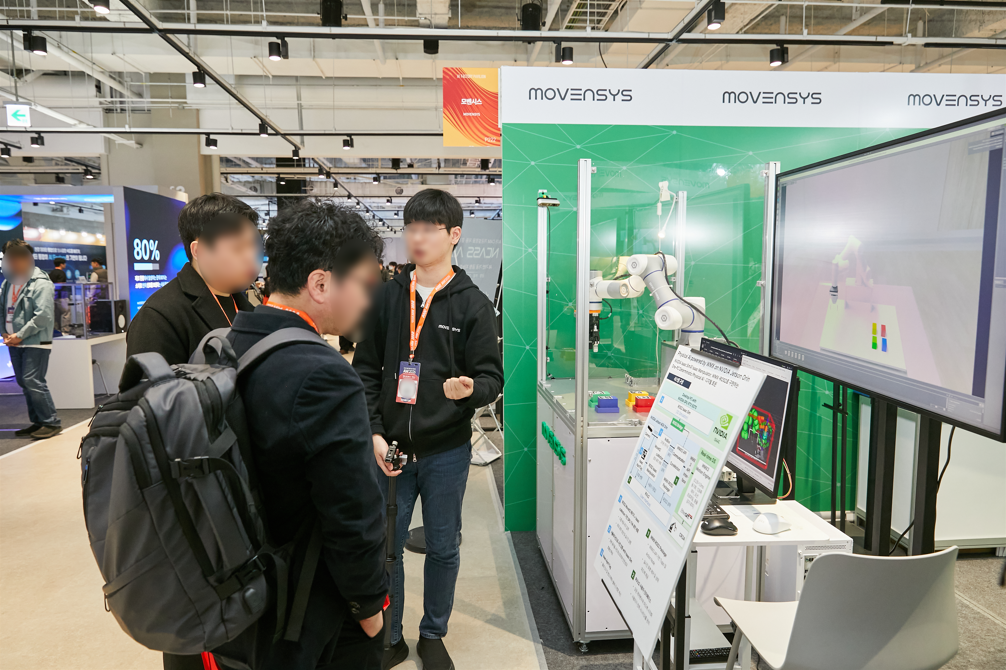
[Photo] Movensys at the AW exhibition last March. Courtesy of Movensys
In semiconductor manufacturing equipment, reaching a precise position is only part of the job. Multiple drive axes must move in step with a set timeline, and the equipment must hold the same process conditions steadily through long hours of operation. Even small timing deviations or communication delays can affect product quality and equipment throughput.
This is exactly the challenge that motion control software company Movensys set out to tackle: implementing motion control functions that once depended on dedicated hardware in software, and making them run reliably on real manufacturing floors. It meant turning a technology proven in the lab into a commercial platform fit for semiconductor mass-production equipment.
Movensys’s flagship product, WMX, is a platform that calculates motion on an industrial PC (IPC) and sends control commands to servo drives and I/O devices over industrial networks such as EtherCAT. Its defining feature is that it implements in software the functions previously handled by separate motion control boards or dedicated controllers such as PLCs.
The core concept behind this technology is Software-Defined Motion Control (SDMC). Where dedicated hardware used to lock together control functions, performance, and scalability, SDMC redesigns them around software. In supported system environments, customers can add functions and licenses to configure their control systems flexibly to fit the characteristics of their equipment.
A Software Control Challenge That Began in an MIT Lab
Movensys’s technical roots go back to when Chairman Bernard Boo-ho Yang was researching robot control in the Department of Mechanical Engineering at MIT.
At the time, industrial motion control was built around dedicated hardware. Even when researchers developed new control algorithms, they had to fit them into the functions and development environment of existing controllers. This limited researchers’ freedom to implement or modify the algorithms they wanted.
Bernard Boo-ho Yang believed PC-based software control could solve this problem. His idea was that as PC computing power advanced, the range of control tasks software could handle would grow as well.
When Japanese manufacturers showed interest in a program developed during his research, he saw commercial potential. This led him to found a company in Boston in 1998 together with his academic advisor. The research and commercialization experience that preceded the establishment of the Korean entity in 2014 became the technical foundation of today’s WMX platform.
The initial goal was to build a software control environment where new algorithms could be implemented freely. But applying lab-built technology to real manufacturing equipment was a different matter. Each customer used different PCs and drive units, and each piece of equipment required different operating conditions. Going beyond simply achieving the desired motion, the company had to maintain the same control quality across a wide variety of equipment environments.

[Photo] Attending the Intel Robotics Workshop on October 14. Courtesy of Movensys
First Mass-Production Deployment: Communication Stability and Changing Specs
The main challenges Movensys faced in its early mass-production deployments were communication stability and frequent changes in customers’ PC specifications. An engineer who handled early communication development cited “securing communication stability and the frequent changes in equipment makers’ PC specs” as the biggest difficulties at the time.
Equipment was connected to servo drives and I/O devices from different manufacturers. Even under the same communication standard, products differed in supported functions, configuration methods, and diagnostic information. The team had to confirm not only that each device communicated properly, but that control remained stable with devices from multiple manufacturers connected at once.
Whenever a customer changed PC specifications, the conditions to be validated changed too. Real-time control performance can vary depending on the processor, motherboard, network devices, and system settings. Even a PC with fast average processing speed must be separately verified to confirm it can deliver control commands within the required time, every time.
Semiconductor manufacturing equipment in particular often moves many axes simultaneously. Synchronization between axes matters as much as the speed and positional precision of each individual axis. Even intermittent communication delays or timing deviations can affect the quality and productivity of repetitive processes.
Solving this requires running equipment for long periods under various load conditions and reproducing abnormal situations to find root causes. After software is modified, it must be rechecked to ensure the change hasn’t affected other functions.
Validation doesn’t end once equipment enters mass production. When PCs or peripheral components are replaced, or new processes and functions are added, previously validated control cycles and communication stability must be checked again. For the flexibility of software-based control to translate into a real competitive edge on the production floor, ongoing technical support and on-site responsiveness are essential.

[Photo] Presentation at Physical AI Tech Day on October 15. Courtesy of Movensys
A Barrier to Entry Built on Proprietary Architecture and 30 Years of Field Validation
WMX connects motion control functions and industrial communication within a single software platform. Equipment developers can use the control functions the platform provides while adding the features they need and integrating with higher-level applications. Its open structure and support for multiple programming languages also let customers configure systems to fit their existing equipment and development environments.
The competitive edge Movensys emphasizes goes beyond simply developing motion control software. It lies in the fact that roughly 30 years of real-time control technology, motion algorithms, system architecture, and equipment validation experience accumulated in industrial settings are concentrated in the commercial WMX platform.
Its differentiation from open-source and general-purpose development tools becomes especially clear when applied to real equipment. Whether source code is open or how convenient development is cannot by itself guarantee the performance and stability of real-time motion control. What’s needed is a proprietary architecture that consistently delivers multi-axis synchronization, integration of diverse industrial networks and drive units, and real-time control performance.
WMX is a commercial platform that integrates these functions on a highly modular software architecture. Movensys has strengthened its technological originality by securing patents related to its SDMC architecture in major markets including Korea, Japan, the United States, Europe, and China.
In the end, what customers buy is not just a control algorithm. It also includes the technical capability to analyze and resolve problems arising in different equipment environments and to keep systems running stably after mass production begins. The combination of proprietary control algorithms, a modular software architecture, and validation experience from semiconductor mass-production sites is what forms Movensys’s barrier to entry.

[Photo] Movensys demo. Courtesy of Movensys
Leveraging Global Partnerships to Move Beyond Semiconductors into Physical AI
Movensys has built up commercialization experience by supplying software control technology to semiconductor equipment makers. Partnerships with global companies such as Mitsubishi Electric and Advantech also underpin its business expansion.
The company collaborates with Mitsubishi Electric in the motion control business and with Advantech in industrial PCs, and continues to hold joint demonstrations and sessions at exhibitions and conferences in Korea and abroad. Through a partnership network that connects industrial computing environments and drive units from various manufacturers, it is broadening the range of equipment its customers can apply it to.
Its business model is to apply control software to equipment makers’ machines and supply licenses. Once the software passes the equipment maker’s design and validation and is adopted for a specific production model, license supply can continue as that equipment is produced. Resolving customer requirements and supporting stable operation during the early adoption stage is key to turning technological competitiveness into revenue.
Building on the technology secured in semiconductor manufacturing equipment, Movensys plans to expand into advanced packaging and high-speed, high-precision manufacturing equipment. As manufacturing processes grow more sophisticated, demands for equipment speed and precision rise, and the company expects the potential of SDMC, which allows control functions to be adjusted and expanded through software, to grow accordingly.
In the medium to long term, the company is focusing on robotics and Physical AI. Movensys’s WMX R2 is a technology that connects motions planned by robot software to real-time motion execution. Turning what AI judges and plans into precise robot movements requires real-time control technology that executes them reliably.
The “One-Chip Physical AI” concept Movensys envisions is an extension of this technical direction. It aims for an architecture that performs everything from perception, reasoning, and motion planning through motion execution on a single commercial processor. The strategy is to extend the real-time control technology accumulated in semiconductor manufacturing equipment into an execution layer that bridges AI’s decisions and movement in the physical world.
Movensys began with an attempt to redefine hardware-centric motion control through software. It will be worth watching how the real-time control technology honed on semiconductor production floors evolves into an execution platform responsible for the movements of robots and Physical AI.
Source : https://www.hansbiz.co.kr/news/articleView.html?idxno=879273
 Next
